Will I Owe Taxes When I Sell My Home in Central Texas?
This is one of the first questions longtime homeowners ask when they start thinking about selling.
And it makes complete sense.
You have lived in your home for 20, 25, maybe 30 years. It has gone up significantly in value. And now you are wondering whether the IRS is going to take a large portion of what you have built.
The answer, for most homeowners in Central Texas, is genuinely good news.
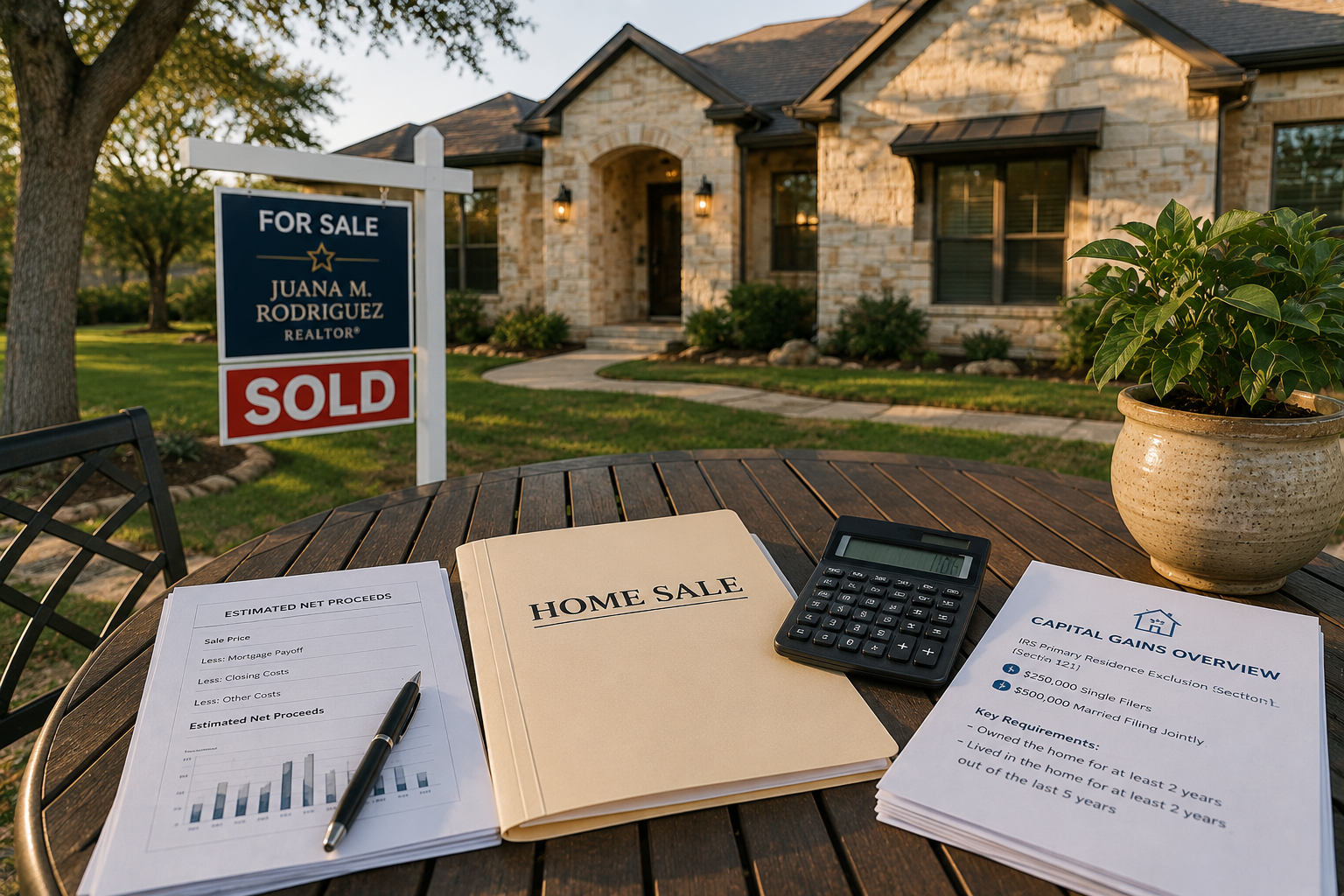
Most people who have lived in their home for at least two years and are selling their primary residence will owe little to nothing in taxes. Many will owe nothing at all.
This article will explain how that works, what the numbers look like, and what you need to know before you sell. It is not tax advice. For your specific situation, your CPA is the right person to call. But this will give you the foundation to have that conversation with clarity.
Does Texas Have a Capital Gains Tax on Home Sales?
No.
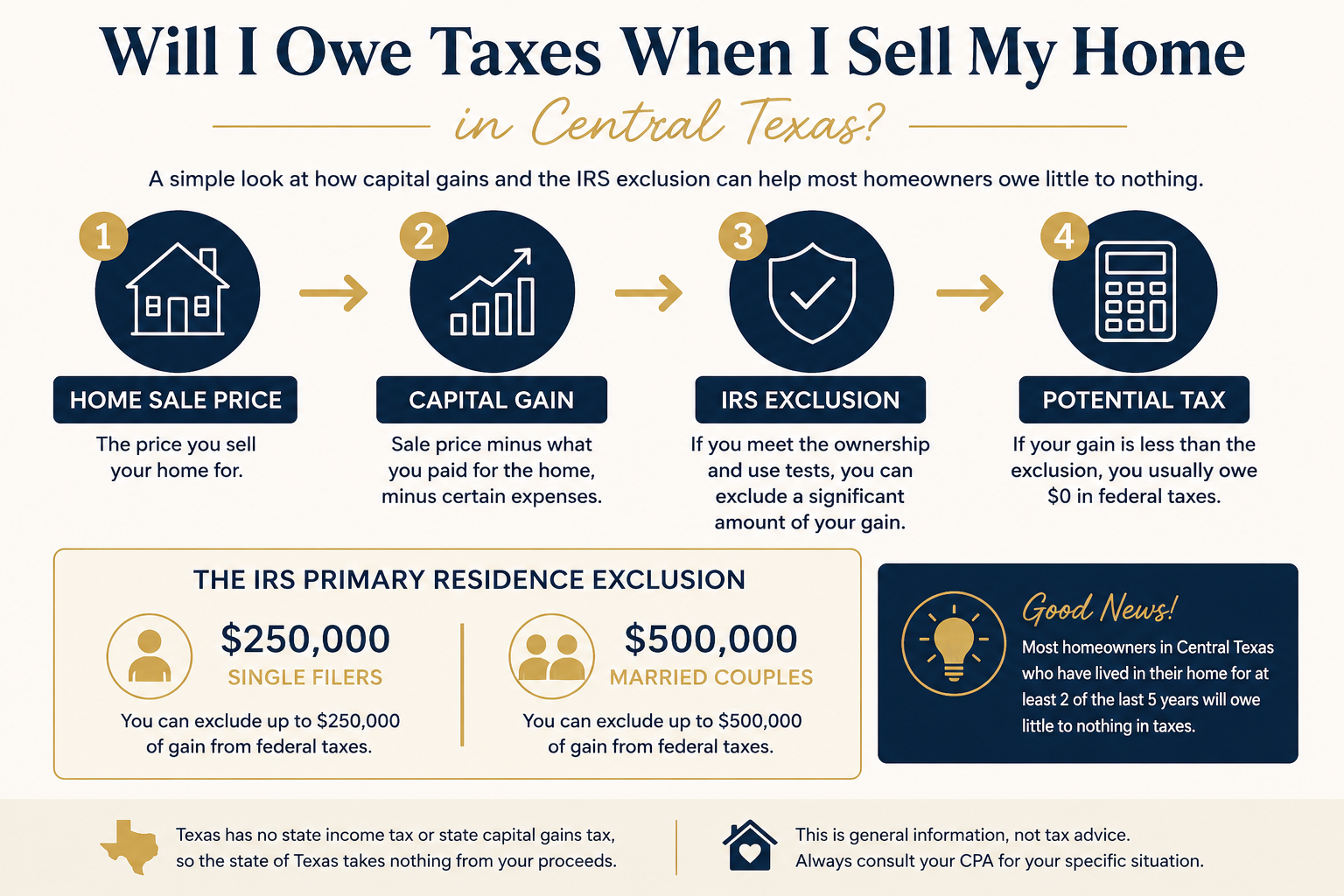
Texas has no state income tax and no state capital gains tax. That means when you sell your home in Georgetown, Salado, Temple, Belton, Killeen, or anywhere else in Central Texas, the state of Texas takes nothing from your proceeds.
This is one of the financial advantages of owning real estate in Texas that does not get enough attention.
You do, however, need to understand the federal rules. That is where most homeowners have questions. And that is what the rest of this article covers.
What Is a Capital Gain on a Home Sale?
A capital gain is the profit you made from selling an asset.
For a home, it is calculated like this: the price you sold the home for, minus the price you originally paid for it, minus certain qualifying expenses.
Here is a straightforward example.
You bought your home in Georgetown in 1998 for $180,000. You are selling it today for $520,000. Your gain is $340,000.
That number sounds large. But here is where the federal exclusion changes everything for most homeowners.
For a full picture of what it costs to sell a home in Georgetown, what does it cost to sell a home in Georgetown Texas walks through every number clearly.
The Federal Exclusion: The Rule Most Homeowners Do Not Know About
The IRS provides what is called a primary residence exclusion under Section 121 of the tax code.
Here is what it means in plain language.
If the home you are selling is your primary residence and you have owned it and lived in it for at least two of the last five years, you can exclude a significant amount of your gain from federal taxes entirely.
•Single filers can exclude up to $250,000 of gain.
•Married couples filing jointly can exclude up to $500,000 of gain.
Going back to the example above. You and your spouse bought your Georgetown home in 1998 for $180,000 and are selling it for $520,000. Your gain is $340,000. As a married couple, your exclusion is $500,000. Your entire gain is covered. You owe nothing in federal capital gains tax.
That is not a loophole. That is the law, and it is specifically designed to protect longtime homeowners like you.
Do You Qualify for the Exclusion?
Most longtime homeowners in Central Texas do. Here are the three requirements.
Ownership test.
You must have owned the home for at least two years out of the five years before the sale.
Use test.
You must have lived in the home as your primary residence for at least two years out of the last five years. The two years do not have to be consecutive.
Frequency test.
You generally cannot have used this exclusion on another home sale within the previous two years.
If you have lived in your Central Texas home for 10, 15, or 20 years, you almost certainly qualify. If you have been renting the home out or using it as a second property, the rules are different and your CPA will need to walk through the specifics with you.
What If My Gain Is Larger Than the Exclusion?
This applies to a smaller group of homeowners, but it is worth understanding.
If your gain exceeds the exclusion amount, only the amount above the exclusion is subject to federal capital gains tax.
Here is an example. You are a single filer. You bought your home for $150,000 and are selling it for $550,000. Your gain is $400,000. Your exclusion is $250,000. The remaining $150,000 is subject to federal capital gains tax.
The rate you pay on that amount depends on your income. For most retirees and near-retirees, the long-term capital gains rate is 15 percent. Some lower-income households qualify for a 0 percent rate. Higher-income households may pay 20 percent.
This is exactly the conversation to have with your CPA before you list. A good accountant can also help you identify improvements you made to the home over the years that increase your cost basis and reduce the taxable gain further.
What About Improvements I Made to the Home?
This is something many homeowners overlook, and it can meaningfully reduce what you owe.
The IRS allows you to add qualifying home improvements to your cost basis. Your cost basis is the starting number used to calculate your gain.
If you paid $200,000 for your home and then spent $40,000 over the years on a kitchen remodel, a roof replacement, or an addition, your adjusted cost basis becomes $240,000. That reduces your taxable gain by $40,000.
Routine repairs and maintenance do not count. But capital improvements, meaning things that add value or extend the useful life of the home, generally do.
Keep records. Receipts, contractor invoices, permit records. If you have been in your home for 20 years, gather what you can. Your CPA can help you determine what qualifies.
What About Property Taxes? Do I Owe Anything There?
When you sell your home in Texas, property taxes are prorated at closing.
This means you pay taxes for the portion of the year you owned the home, and the buyer takes responsibility for the rest. It is handled through the title company as part of the closing process. You do not have to figure it out yourself.
If you have been receiving a homestead exemption, over-65 exemption, or disabled veteran exemption on your property taxes, those exemptions end when you sell and transfer to the new owner's situation.
Some homeowners in Central Texas have also had their tax increases frozen through the over-65 school tax ceiling. That ceiling does not transfer to your next home automatically, but many Texas counties allow you to transfer a percentage of it. Worth asking your CPA or county appraisal district about before you sell.
What Will I Actually Walk Away With?
This is the question underneath the tax question.
Your net proceeds from a home sale are your sale price, minus your real estate commission, minus closing costs, minus any remaining mortgage balance, minus any capital gains tax owed.
For most longtime Central Texas homeowners selling their primary residence, the tax piece is minimal or zero. The larger variables are the sale price itself and what it cost to get there.
That is where the right agent makes a meaningful difference. If you want to understand what preparation actually matters before listing, what increases home value before selling in Central Texas walks through exactly that.
Not just in negotiating your price, but in helping you understand what preparation matters, what does not, and how to position your home to sell well in the current market.
Knowing your net number before you list is how you make decisions with confidence instead of guessing. When you are ready to think about next steps, the step-by-step process to sell a home in Central Texas gives you a clear overview of how the full sale works.
A Practical Checklist Before You Sell
Here is what I recommend every longtime homeowner do before listing:
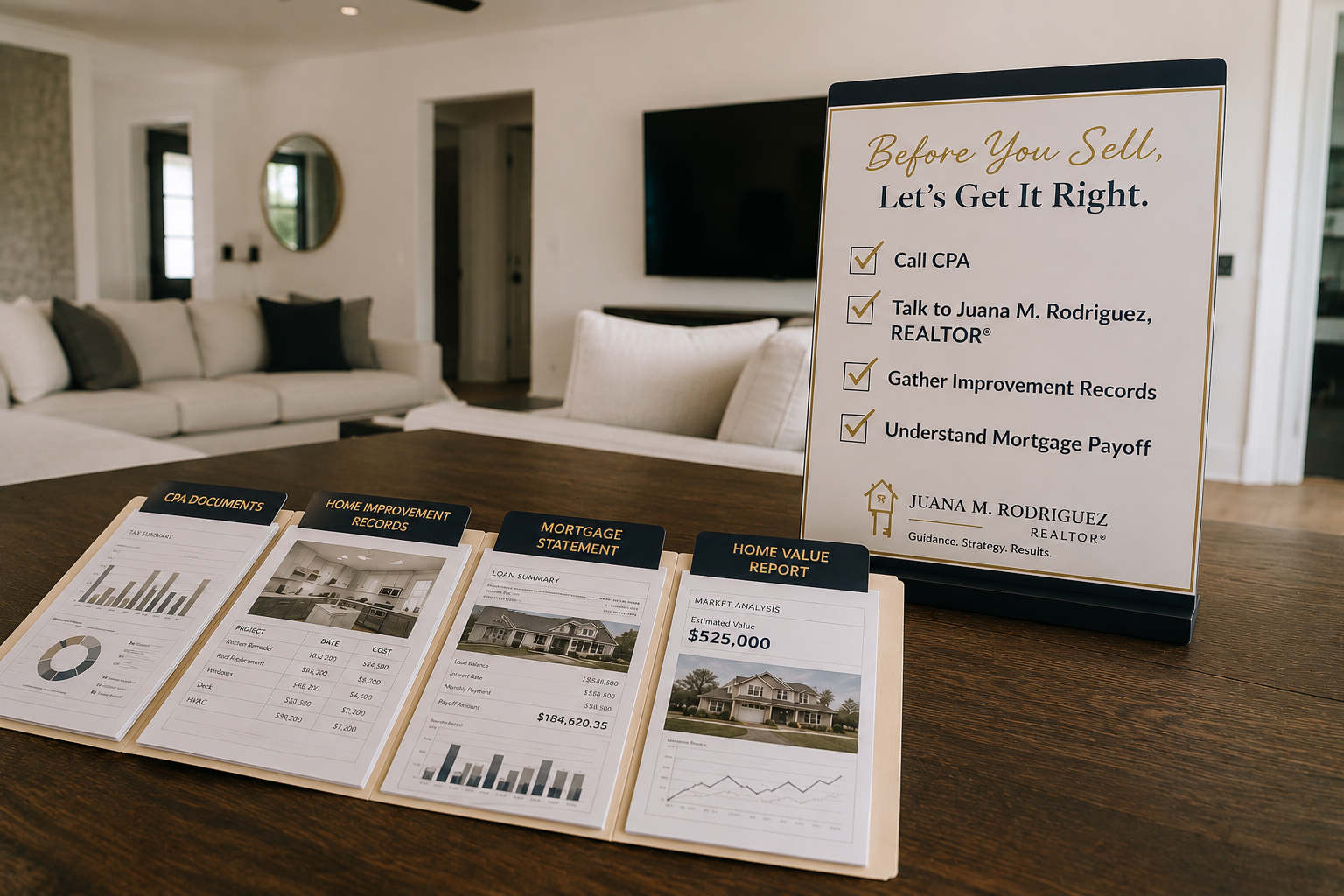
•Call your CPA. Share your purchase price, the year you bought, and a rough estimate of your expected sale price. Ask specifically about your capital gains exposure and whether your improvements can increase your basis.
•Gather your improvement records. Think back through any major projects. Roof, HVAC, additions, remodels. Receipts and permits are ideal. Estimates work if that is all you have.
•Understand your mortgage payoff. Contact your lender for a current payoff amount. This tells you your equity position clearly.
•Talk to a real estate agent who knows your market. Pricing is where most of the financial outcome is determined. Getting that right from the start is what protects your equity.
Frequently Asked Questions
Does Texas have a capital gains tax on home sales?
No. Texas has no state income tax and no state capital gains tax. Any tax consideration when selling your home in Central Texas is at the federal level only.
How much of my home sale profit is tax-free?
If you are married and file jointly, you can exclude up to $500,000 of gain from federal capital gains tax on the sale of your primary residence. Single filers can exclude up to $250,000. To qualify, the home must have been your primary residence for at least two of the last five years.
What if I have lived in my home for more than 20 years and it has gone up a lot in value?
Most longtime homeowners in Central Texas will still qualify for the full exclusion. Whether you owe anything beyond that depends on the size of your gain, your filing status, and your income. This is the conversation to have with your CPA before you list. Many homeowners in this situation owe little to nothing.
Do home improvements reduce what I owe in taxes?
Yes. Capital improvements you made to the home over the years can be added to your cost basis, which reduces your taxable gain. Routine maintenance does not qualify, but significant projects like a roof replacement, kitchen remodel, or addition often do. Gather whatever records you have and review them with your CPA.
What happens to my property taxes when I sell?
Property taxes are prorated at closing. You pay for the portion of the year you owned the home. The title company handles this calculation as part of the closing process. If you have been receiving an over-65 or homestead exemption, that ends when ownership transfers.
Should I talk to a CPA before listing my home in Central Texas?
Yes. Every situation is different. Your CPA can calculate your specific gain, identify improvements that increase your basis, and tell you exactly what you will owe, if anything, before you go to market. Having that number in hand lets you make decisions with full clarity. Your real estate agent can help you understand the market side. Your CPA handles the tax side. Both conversations are worth having early.
Who can help me sell my home in Central Texas if I am downsizing?
Juana M. Rodriguez is a REALTOR® with eXp Realty specializing in downsizing and probate real estate across Georgetown, Salado, Temple, Belton, Killeen, Harker Heights, and surrounding Central Texas communities. She works with longtime homeowners navigating major life transitions and focuses on protecting equity, clear pricing strategy, and a structured approach that removes the guesswork. You can reach her at (254) 312-5660 or [email protected].
Ready to Understand Your Numbers?
If you want to understand what your home is worth in today's Central Texas market and what you would realistically walk away with, I am glad to walk through it with you.
No guesswork. Just a clear conversation about where your home stands and what the process looks like for your situation.
Call me at (254) 312-5660, email [email protected], or schedule a time that works for you.
Juana M. Rodriguez, REALTOR® with eXp Realty
Guiding Your Next Chapter
Helping Central Texas homeowners downsize, buy, sell, and move forward with clarity and confidence.
(254) 312- 5660 | [email protected] | https://home.juanamrodriguez.com/home
Central Texas Real Estate Answers Blog: https://centraltexasrealestateanswers.juanamrodriguez.com/answers
YouTube | Instagram | TikTok | Threads: @juanamrodrigueztx